






Many people experience the occasional night when a busy, anxious mind makes it difficult to sleep. But if this happens […]
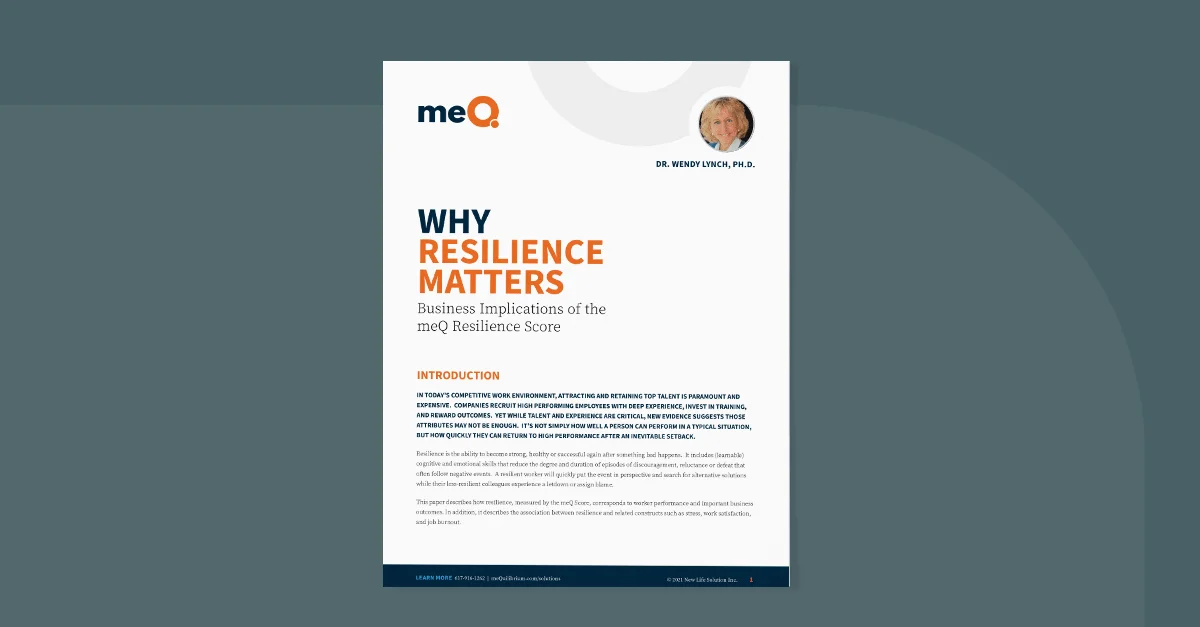
Business Implications of the meQ Resilience Score By Dr. Wendy Lynch, Ph.D.
Attracting and retaining top talent is expensive. Organizations invest heavily in recruiting experienced, high-performing employees, training them, and rewarding results. But talent and experience aren't the full story. What matters just as much is how quickly an employee can bounce back after an inevitable setback.
Resilience is the ability to become strong, healthy, or successful again after something bad happens. It's built from learnable cognitive and emotional skills that shorten the degree and duration of discouragement, reluctance, or defeat that often follow negative events. Resilient employees put setbacks into perspective and look for alternative solutions. Less resilient colleagues are more likely to experience a letdown or assign blame — and stay stuck there longer.
This page summarizes independent research on how resilience, measured by the meQ Score, connects to employee performance and the business outcomes leaders care about most: stress, burnout, job satisfaction, absenteeism, productivity, turnover, and employer brand.
This validation study was conducted by Dr. Wendy Lynch, Ph.D., scientist and founder of Lynch Consulting, at meQ's request to provide independent, third-party, unbiased science. The study was conducted in 2015 against six third-party tools with a national panel of more than 2,000 respondents, using industry-accepted methods. The outcomes are supported by third-party, peer-reviewed, and clinically validated research.
Dr. Lynch is a behavioral scientist whose work spans health management, productivity assessment, and human capital management. She is the author of two books on the economics of health care and business, more than 50 articles and reports, and was named one of Forbes' "Thirteen to Watch" for unsung heroes changing health care.
Methods: Over 2,000 respondents from a national panel completed a survey combining items from the meQ Score with several established instruments, including the Psychological Capital Scale, the Copenhagen Psychosocial Questionnaire, the Perceived Stress Scale, and the Work Productivity and Activity Impairment Questionnaire (WPAI). Lie-scale questions were embedded throughout to screen out unreliable responses. Respondents were divided into quartiles by meQ Score, and multiple regression models — controlling for age and gender — translated meQ Scores into meaningful, real-world units of other outcomes.
The meQ Score correlates significantly with other validated measures that matter to business outcomes. Higher meQ Scores are strongly associated with lower perceived stress, higher Psychological Capital (a well-researched state combining self-efficacy, optimism, hope, and resilience), better general health status, and higher job satisfaction — and with lower burnout and presenteeism. All relationships are statistically significant at p<.01.
Takeaway: Higher meQ Scores reflect lower stress and stronger stress-management skills. In practical terms, that means employees who are happier at work, performing better, and feeling better both physically and emotionally.
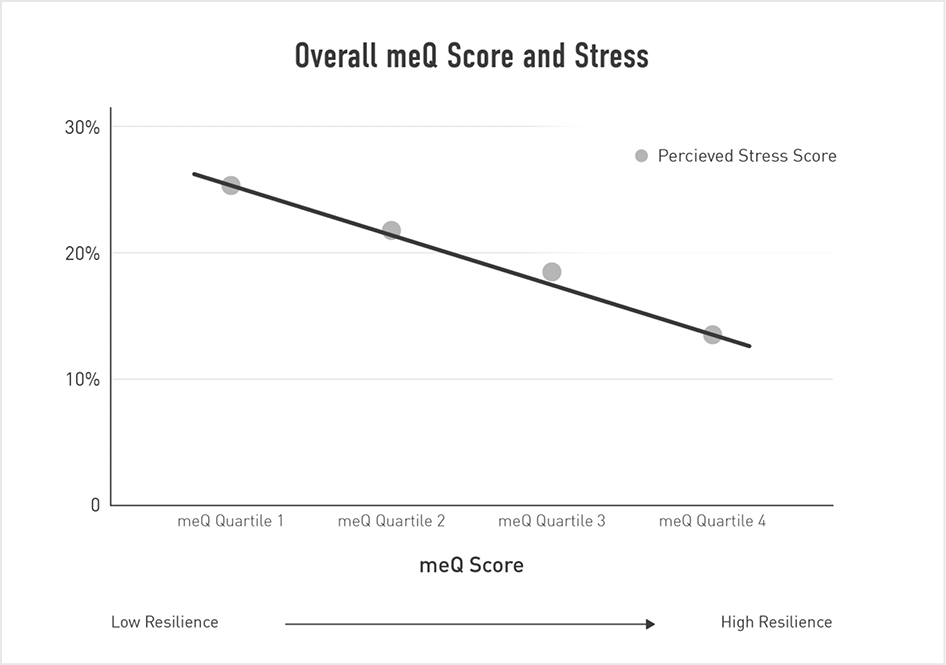
The Perceived Stress Scale (PSS) is the most common and respected way to measure how stressful people find their life situations. When PSS scores are compared against the meQ Score, the relationship is strong and negative: higher resilience scores consistently correspond to lower perceived stress.
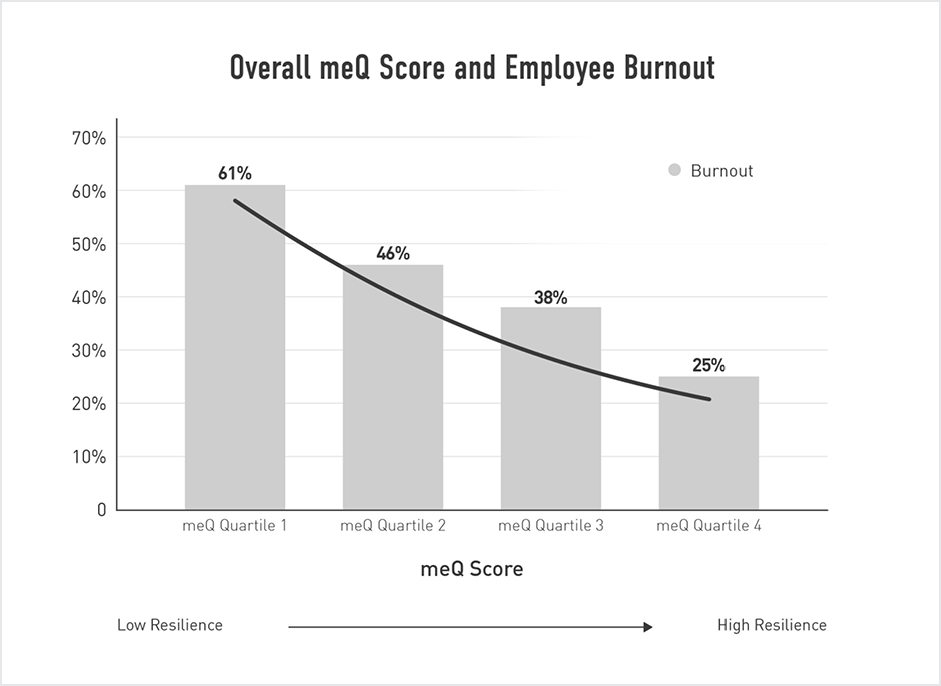
Burnout scores are more than twice as high for employees in the lowest meQ quartile compared to those in the highest. Burnout signals reduced motivation and reduced effectiveness on the job — a direct hit to organizational performance.
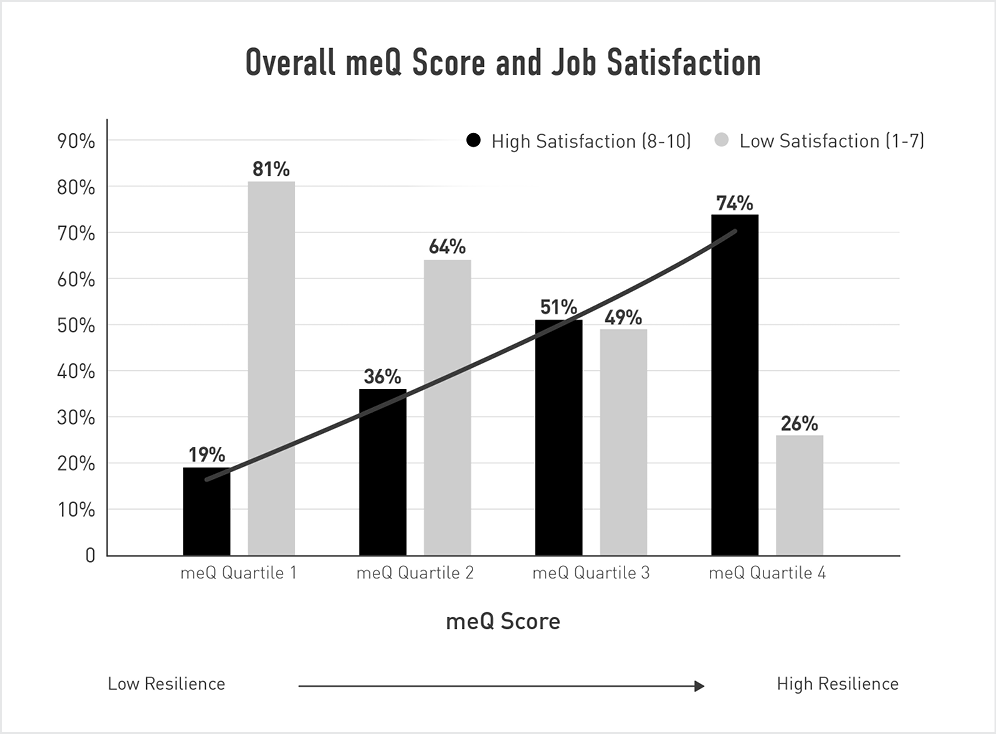
Job satisfaction is closely tied to attendance, performance, and turnover — and it tracks closely with resilience. Almost four times as many employees in the top meQ quartile (74%) report high job satisfaction compared to those in the bottom quartile (19%). Satisfied employees are also more likely to deliver strong customer service and better business results.
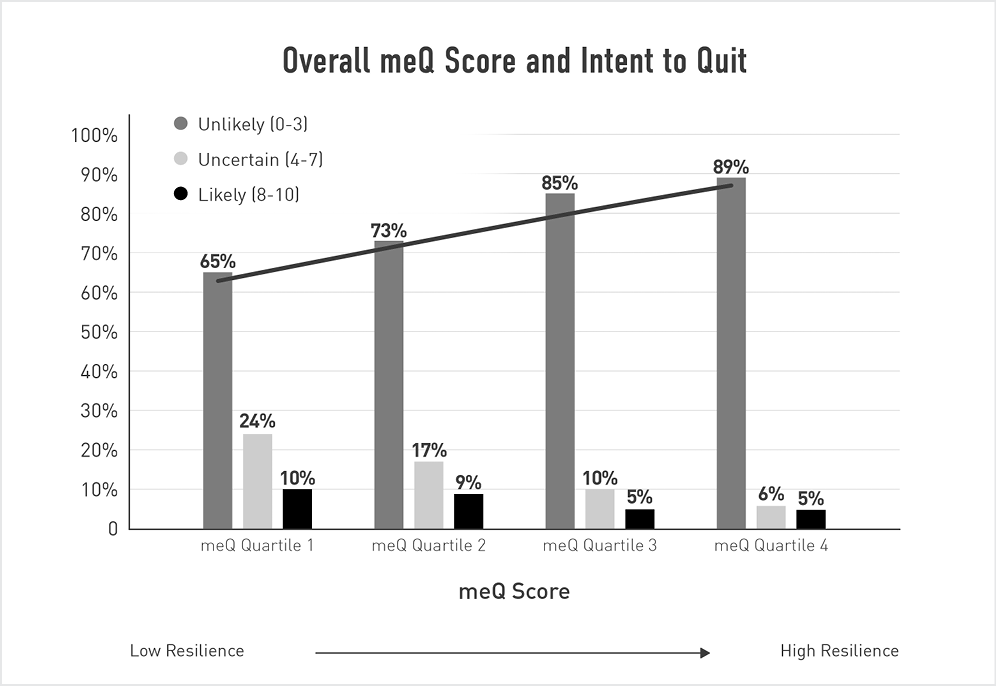
Employees with the highest resilience are the least likely to plan on leaving their jobs. In fact, 89% of the most resilient employees say they're very unlikely to quit within six months, compared to just 65% of the least resilient. Employees with the lowest resilience are also four times more likely (24% vs. 6%) to say they're uncertain about staying.
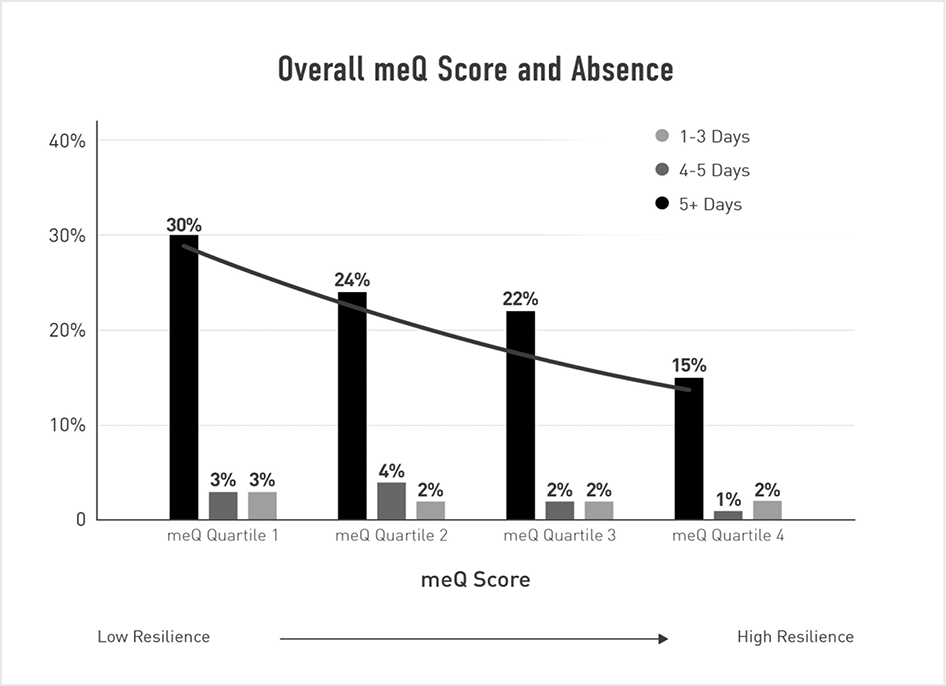
Resilience has its biggest impact on short-term, incidental absences. Employees with low resilience are twice as likely (30%) to report a 1–3 day absence in the past month compared to those with the highest resilience — a meaningful cost for any role that requires backfilling unscheduled absences.
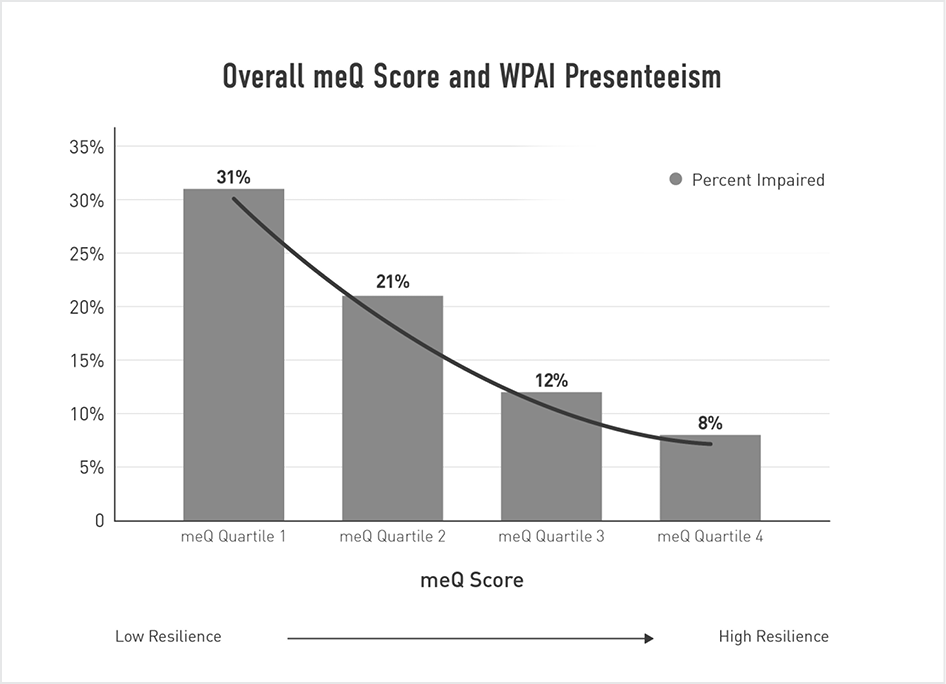
Resilience is directly tied to performance while at work. Employees with the highest meQ resilience report only 18% productivity impairment, compared to 41% for those with the lowest resilience.
For a job with a $50,000 salary, that difference in impairment is conservatively worth $4,500 per employee, or $450,000 per 100 employees.
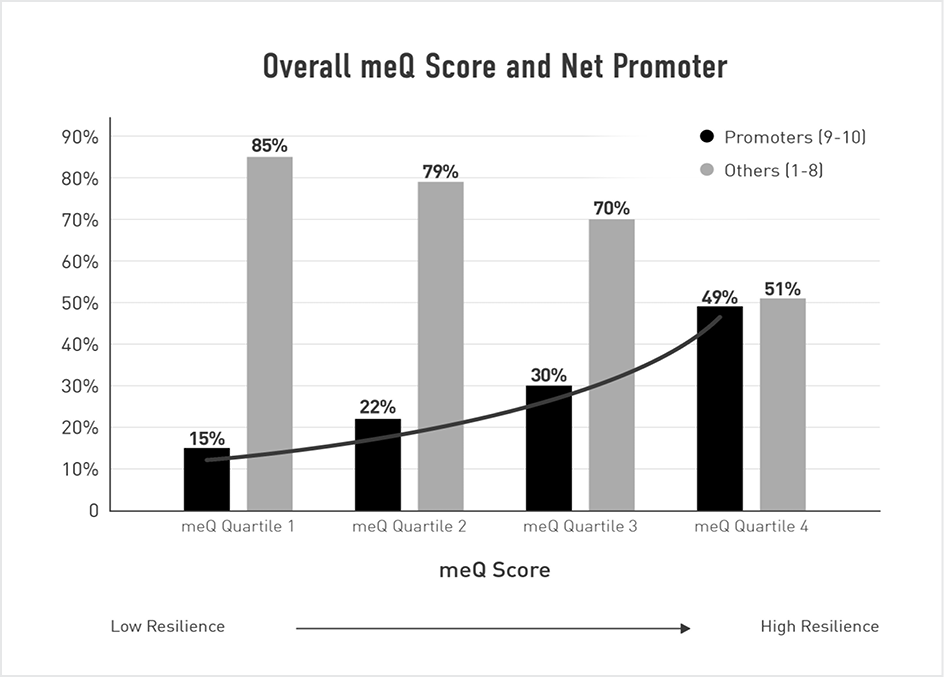
In an era when employees are essential brand ambassadors, the link between resilience and how employees view their employer is critical. Nearly three times as many employees with high resilience — almost half — qualify as brand "promoters," compared to only 15% of employees with low resilience who would recommend their organization to friends or colleagues.
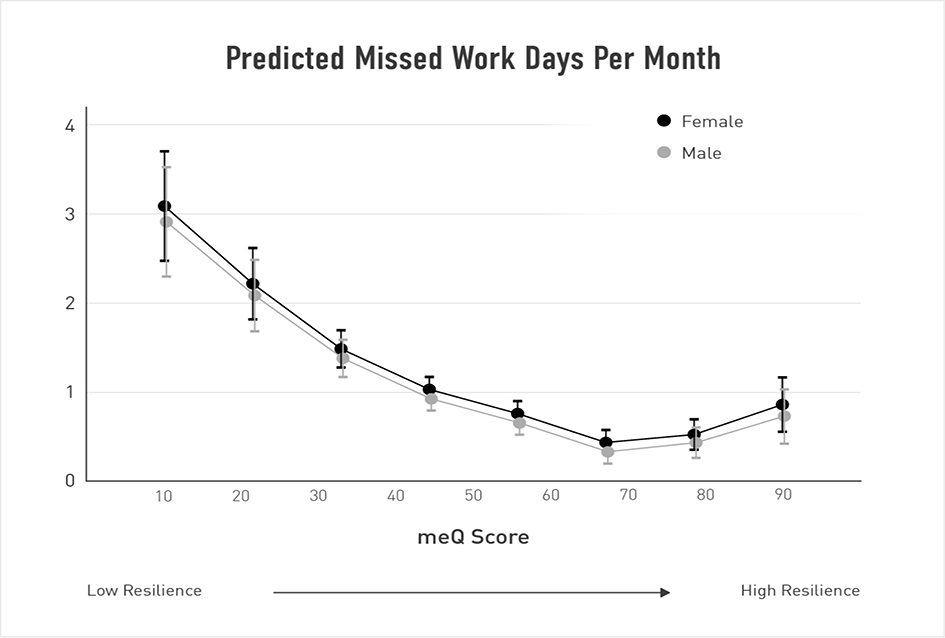
HR professionals often ask how to interpret meQ Scores and the differences between them. To answer this, researchers calculated the effect of a one-point change in meQ Score. As expected, gains at the low end of the resilience spectrum produce bigger benefits than the same size gain at the high end. Someone who improves from a score of 35 to 40 (out of 100) will see greater benefit than someone who moves from 85 to 90.
The pattern is curvilinear: the steepest predicted decline in missed workdays happens as scores move through the 15–60 range; above 60, the absenteeism curve flattens. Across the full spectrum, the average reduction in absenteeism tied to a one-point increase in meQ Score is 0.24 days per year — roughly one fewer absence for every four people. The same curvilinear pattern shows up across presenteeism and intent to quit, meaning resilience-building efforts deliver the greatest return for employees who start out with the lowest resilience.
Because resilience touches so many outcomes, research predicts that raising resilience improves stress symptoms and illness rates, absences, disability rates and duration, turnover, work engagement, and productivity. Published research confirms that increasing resilience leads to improved performance, reduced absence, and reduced turnover.
A well-designed resilience program typically improves overall resilience by about 30% — often more. At that level of improvement, organizations can see topline performance gains of up to $870,000 for 10,000 eligible employees, along with $347,000 in annual savings from reduced absence and turnover.
| Annual savings tied to improvement in resilience | |||
|---|---|---|---|
| Resilience improvement | 23% | 30% | 37% |
| Improved productivity | $721 | $940 | $1,159 |
| Reduced absenteeism | $232 | $303 | $374 |
| Lower turnover | $55 | $72 | $89 |
| Reduced depression risk | $109 | $142 | $175 |
| Annual savings per participant | $1,117 | $1,457 | $1,797 |
| Annual savings per 10k employees | $837,775 | $1,092,750 | $1,347,725 |
Assumptions: 25% enrollment in the resilience program. 30% monthly engagement. Average salary of $50,000. 10% turnover; average time to fill position is 4 months.
Resilience can be measured — and the meQ Score corresponds to other validated instruments in ways that confirm its construct validity. Employees who score high on the meQ Score show lower stress and burnout, and demonstrate greater efficacy and optimism than those who score low.
Resilience, as measured by the meQ Score, is tied to the business outcomes that matter most: absence, productivity, anticipated turnover, job satisfaction, and net promoter score. Even small, conservative gains in resilience translate into significant business value, proof that investing in employee resilience isn't just good for people; it's good for the bottom line.