




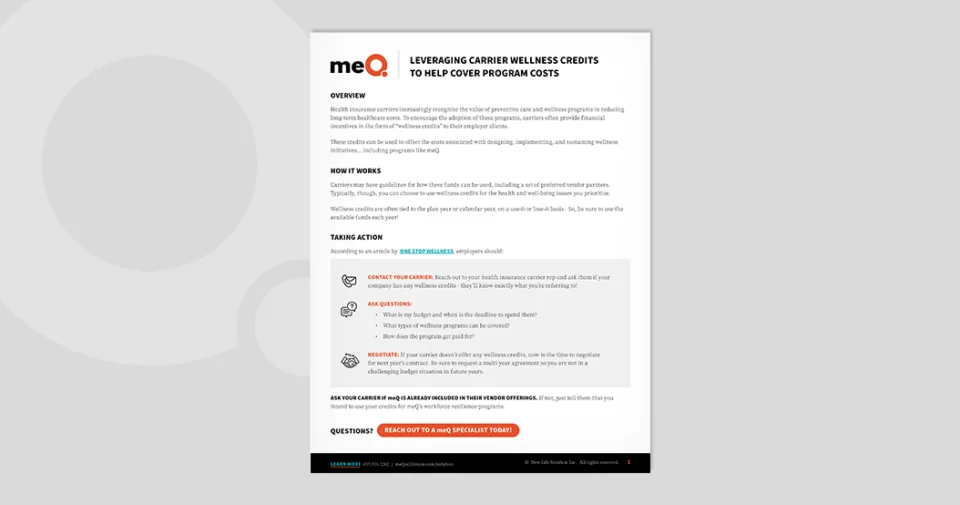
To encourage wellness programs as part of your HR ecosystem, many healthcare carriers have introduced wellness credits. Learn how wellness […]
The stress that comes with today's unrelenting workplace change is well documented. Supporting employee mental wellbeing through programs and tools is necessary, but it is also essential to understand where your workforce stands with regard to well-being risk, and how your programs are impacting this over time.
Roche is a global leader in healthcare with employees in 100 countries around the world and an established culture of well-being. One element of this is an annual dedicated effort to measure psychosocial risk on a global scale. This initiative, the K1 Annex 5 work environment assessment, looks at factors such as how much is asked of employees, how much support is provided, and how much control they have over their work, and aims to unearth any emerging risks such as workplace incivility, bullying, or other negative workplace situations.
The resulting report is comprehensive, but not easy to work with. The company's well-being strategist felt that meQ's robust reporting and action tools would improve the output of this global analysis effort, and invited meQ to collaborate on the latest assessment to improve the process, streamline reporting, and make the results more actionable.
At a session during The Conference Board's 2023 Employee Health Care Conference in New York, meQ's Chief Science Officer, Brad Smith, Ph.D., and U.S. Roche Genentech's Senior Benefits Manager, Josh Freund, shared the story of the project — and the results.
"We started with the Copenhagen Psychological Inventory, or COPSOQ," said Freund. "This initially gave us 46 domains that we felt were important to measure for insight into our work environments and how they might be impacting our employees' mental health."
The COPSOQ is a globally used, proven instrument to gather valid and reliable information about psychosocial risk factors. Domains include a wide range of topics such as work pace, influence at work, possibilities for development, and role clarity.
"The COPSOQ has been around for decades," said Smith. "For the meQ Science Team and for Roche, it was a priority to use a well validated, evidence-based tool."
Over several months, the Roche/meQ team carefully customized the tool into an eight-minute, 40-item survey to measure the 10 domains most relevant to Roche's risk assessment policy:
The team also readied meQ's analytics infrastructure to capture survey responses, analyze results against Roche-wide norms and published benchmarks, and offer recommendations for building more effective leaders and teams.
"We fielded the survey company-wide to 24,000 employees and 10,000 contractors — and we had a 50 percent response rate. That's phenomenal, unbelievable." — Josh Freund
The high response rate meant a plethora of data to analyze. meQ's powerful Workforce Intelligence platform gave Roche a flexible reporting tool to identify both strengths and opportunities for improvement across business units, demographic groups, job titles, and other employee characteristics.
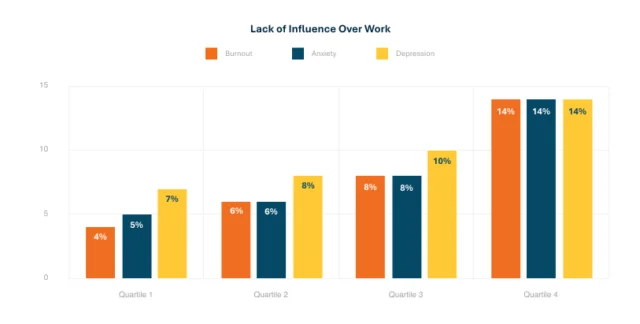
First, the team examined the reports to identify psychosocial risks to the whole organization. What they found was remarkable, but in keeping with meQ's data across its book of business: on every topic surveyed, employees who reported greater workplace psychosocial risks had greater risks of burnout, anxiety, and depression.
Next, they explored the risks for specific job functions, including R&D, finance, and packaging, which all showed psychosocial strains compared to company norms, in such categories as lack of control over working time and lack of meaning at work.
As Freund explained, "When we know, for example, that R&D scores higher on cognitive demands, or finance reports a significant lack of meaning at work, we can bring that data to the leadership in those teams. We can explore the way that the jobs are designed and the environment in which these employees are working that's causing these kinds of risks."
Insight: Lack of Control Over Work Time
Group: Manufacturing Unit
Percent at Risk: 95%
The third step for Roche was the ongoing process of risk mitigation.
"It's important to follow these surveys with action," affirmed Freund. "You open up more risk for the organization if you survey employees on risks to mental health, but then don't show your people that you're actually doing anything about it."
Smith and Freund acknowledged that some job functions contain risk by their very nature. For example, assembly line work doesn't come with a lot of schedule autonomy. Furthermore, redesigning entire work environments is a bigger, often slower undertaking that may involve many departments.
"The immediate mitigation question then becomes, how do we program for the stressors?" noted Freund. "Getting into the specifics on risks to different job functions helps us narrow our focus and pilot processes, activities, and benefits programs that we believe can help reduce these risks. Where can we help packaging employees address anxiety and depression? What will help R&D employees manage the high cognitive demand? And then we can precisely target those resources to those job families."
meQ Workforce Campaigns helps the team deploy curated, personalized resilience training to address specific risks in specific domains. The resources include digital lessons, videos, activities, and live webinars.
Moving forward, Roche will also continue to implement data projects to understand psychosocial risk and mitigation needs.
"Solving for psychosocial risk asks us to be curious and collaborative, as we share and explore data in creative ways," said Smith.
"This project has been a really, really good first step. I think we can go a lot further, and I'm excited to keep doing this work with meQ." — Josh Freund