










When the holidays roll around, even those of us who normally eat healthfully can overindulge. Special foods abound—cooked by loved […]
Manufacturing companies across the globe are navigating unprecedented structural change, supply chain disruption, and economic turbulence. For one Fortune 50 manufacturer, these pressures were directly threatening workforce stability — especially among hourly, non-desk workers.
Hourly manufacturing roles are classified as high-strain jobs: workers face limited autonomy, unpredictable scheduling, and physically demanding conditions. Research consistently links high job strain to serious negative physical and mental health consequences, including burnout, absenteeism, and reduced productivity.
The macroeconomic environment made retention even harder. According to the Bureau of Labor Statistics, quit rates post-pandemic are 24% higher than pre-pandemic levels — a trend that hit hourly workers in non-desk roles particularly hard.
An initial meQ workforce assessment revealed alarming results at this company:
Without intervention, the company faced a compounding cycle: stress and burnout leading to turnover, turnover driving operational disruption, and disruption creating more stress.
Recognizing that turnover was both a human and financial threat, the company launched a comprehensive workforce resilience initiative powered by meQuilibrium (meQ) — a science-based platform designed to build individual and team resilience, mental wellbeing, and change agility.
The program included:
To rigorously measure the program's effect on retention, meQ's Workforce Outcomes data science team conducted a controlled 12-month study across a population of more than 85,000 hourly workers.
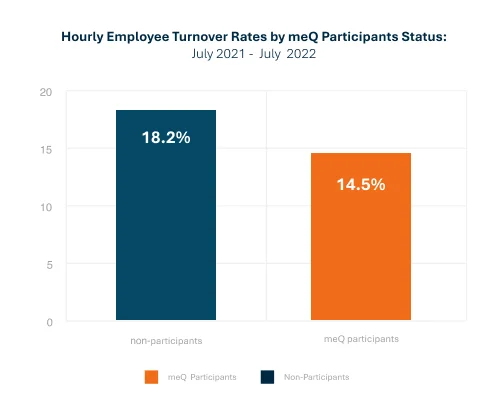
The study compared turnover rates between meQ participants and a matched control group of non-participants. Matching methodology controlled for variables such as age, gender, role, and hire date — ensuring a fair, apples-to-apples comparison.
The data told a clear story:
Assuming an average hourly worker salary of $50,000 and a replacement cost of 25–40% of annual salary, the company realized an estimated:
$5.1 million to $8.1 million in turnover cost savings
Beyond the numbers, four years into the partnership the company's Chief Medical Officer and Chief Human Resources Officer recognized a fundamental shift: meQ was no longer just a wellness tool — it had become a performance driver.
These senior leaders are now collaborating with meQ to design and deploy best-in-class hybrid (digital + live) resilience training, embedding mental fitness as a core component of company culture.
This case study demonstrates that workforce resilience is not a soft benefit — it's a measurable business lever. Manufacturers that invest in employee mental wellbeing and stress resilience can expect:
The ability to quantify impact — through matched-sample studies and rigorous outcome tracking — is what separates performative wellness programs from programs that move the needle on retention, productivity, and performance.
meQuilibrium is a workforce resilience platform that uses science-backed assessments, personalized training, and predictive analytics to help organizations build resilient, agile, and mentally healthy workforces. meQ serves enterprise clients across industries including manufacturing, healthcare, financial services, and retail.
Learn how meQ can help your organization reduce turnover and build workforce resilience. Schedule a no-pressure call with a meQ specialist.