High Anxiety and Healthcare Workers: How to Support the Front Line
Healthcare providers continue to face ongoing stress as COVID variants, vaccine hesitancy and rising caseload bring an already stressed healthcare […]
Healthcare providers continue to face ongoing stress as COVID variants, vaccine hesitancy and rising caseload bring an already stressed healthcare […]
Healthcare providers continue to face ongoing stress as COVID variants, vaccine hesitancy and rising caseload bring an already stressed healthcare system to the brink. The requirement of physical presence with the potential of contracting or spreading disease, coupled with the emotional strain of caring for frightened and sick patients require high levels of emotional intelligence, self-care, emotion control, and stress management.
Supporting workers in frontline positions so that they are able to manage the stress and emotions that come with the job—especially as the pandemic heads into its second year is a priority in order to see this workforce perform safely.
Not only does each worker’s ability to manage stress have a ripple effect on their patients, co-workers, and families, managing stress effectively will protect their immune systems as they face daily challenges. But the responsibility to “cope better” should not rest solely with individual employees. Having supportive teams, managers, and organizations is critical.
Insights into comprehensive assessments of the state-of-mind from a national sample of more than 7,000 frontline workers, including healthcare professionals, illuminates the path for how we can best support them. We can help them improve their ability to manage through a difficult time, and empower them to support themselves and those they care for.
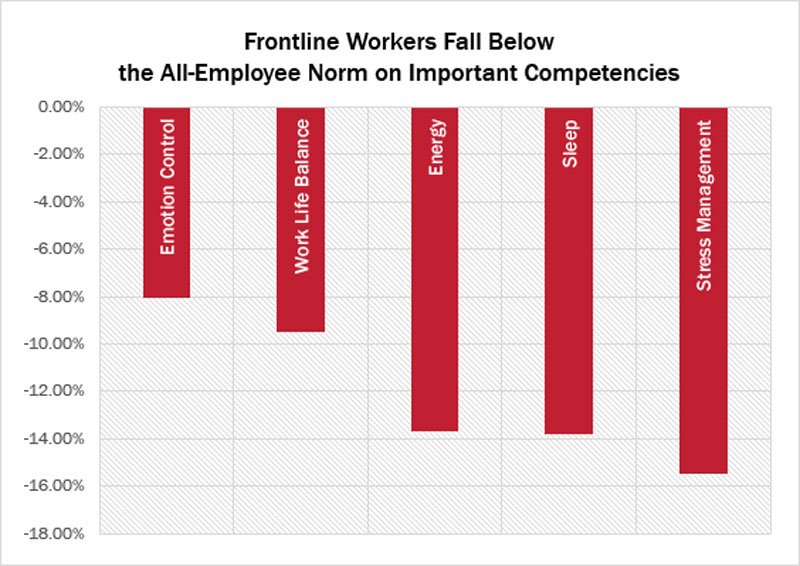
The plan to support employees and their managers should include building the skills needed to cope with the anxiety they face. Based on more than a million data points from workers on the front lines, we see that this segment of employees falls below the norm for all workers on emotion control, work-life balance, energy, sleep and stress management. This means that their ability to cope is particularly low, putting them at greater risk when the world around them becomes overwhelming. Building competencies in these foundational skills, both in managers and employees, is critical to help support calm, communication, and resilience in trying circumstances.
The basic cognitive and emotional skills needed to alleviate the risk of crumbling under stress can be learned. For instance, meQuilibrium members working on the front line and struggling with stress improved 70% with training.
Vulnerabilities of Caregivers
Healthcare workers predominantly fall into the meQuilibrium personality category of “Caregiver.” Caregivers have high levels of empathy and are prone to challenges managing energy (36% are at high risk for burnout) and mental health issues including depression and anxiety.
Caregivers have a keen sense of what others need and can get things done. They’re an asset to any team and they’re there for those whom they love. They’re everyone’s go-to-person, but their well-being suffers significantly when they can’t keep up with growing demands. For example, employees with low stress management are five times more likely to become clinically depressed.
Thinking Traps are Common
About 50% of healthcare industry employees tend to engage in thinking traps-thoughts that called “worst case thinking” or “catastrophizing”. That means that when they perceive threat, their mind goes quickly and automatically to the worst possible outcome. It’s helpful for managers and organizations to communicate in a way that accounts for this reality and points calmly to the most likely outcome of the situation rather than the worst possible one.
Understanding Emotion Under Stress is Important
Two of the most common “go-to emotions” ( the emotions to which people default under stress) are anger and anxiety. Anger is an externalization of emotion—it looks like finding blame in others and taking stress out externally. Anxiety is fear of a future threat. Our brains are wired to scan for threats, so in times when threat levels are unusually high, it’s important to know how to recognize and correct for intense emotional reactions to the situation. It’s important to put others’ behavior in context of the stress they may be feeling and instead of responding to the worst aspects of their behavior, seek to recognize what’s behind it and solve the root cause, which is stress.
The impact of managers’ and employees’ actions is heightened at a time like this, so taking steps to manage emotions and stress reactions is critical. All improvements in managing emotion and boosting positivity will ripple out across the healthcare workforce, patients and families affected by the challenges at hand.