





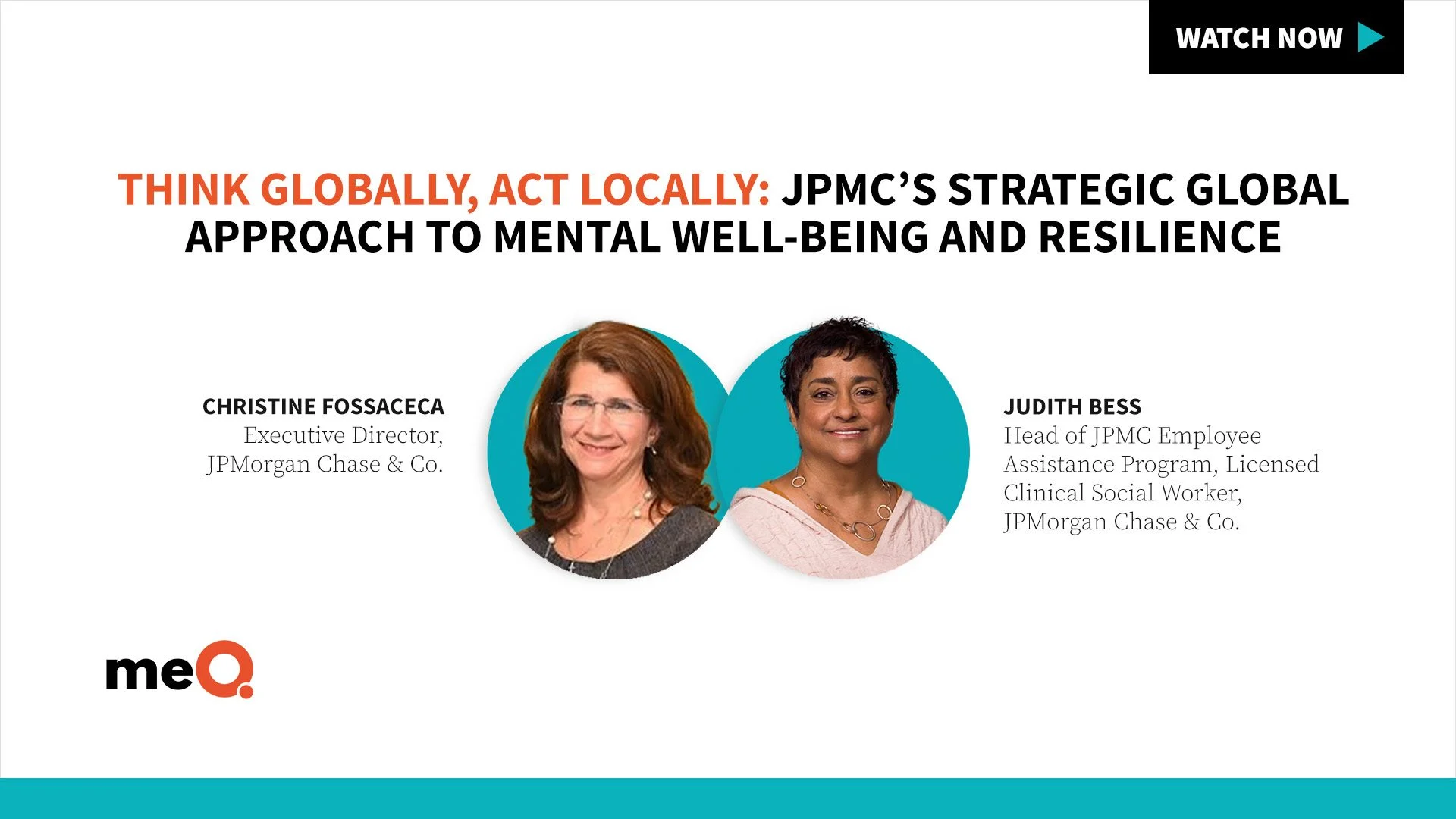

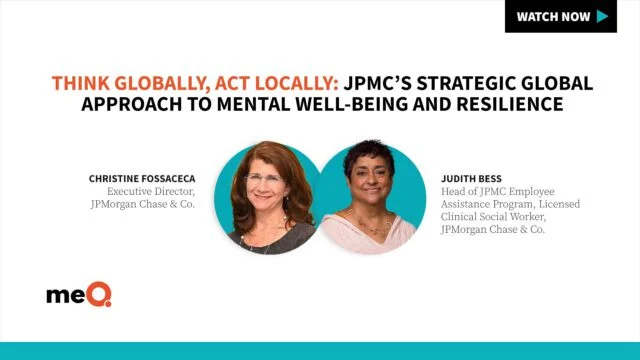
Discover how JPMC designed a global well-being strategy that resulted in high participation and excellent outcomes.
A health insurance company with more than 10,000 employees implemented meQ's personalized resilience platform to modernize its well-being strategy for a hybrid workforce. The results:
Across a workforce of more than 10,000 employees, this health insurance company built its well-being strategy around a simple principle: every employee should have the opportunity to thrive. As the company's Well-being Project Manager explained, employee health and well-being is inseparable from organizational success; it affects both individual employees and the performance of the business as a whole.
That philosophy pushed the company to modernize how it delivered and measured workforce well-being.
For years, the company had run an activity-based wellness program. But as the workforce shifted toward remote and hybrid work, that model no longer fit employee needs.
Using employee health interest surveys, focus groups, and ongoing pulse surveys, the company's well-being team identified a clear pattern: employees wanted well-being support that was available virtually and tailored to where each person was in their personal well-being journey.
The team needed a solution that could:
That search led the company to meQ's personalized employee resilience platform.
The company took a phased, approach to rollout:
This risk-stratified rollout allowed the company to validate outcomes with its highest-need employees before scaling company-wide, a model increasingly common among enterprise well-being programs looking to prove ROI before full deployment.
Measured using meQ's Resilience Indicator Index (RII), which tracks improvement across the four resilience factors where each individual has the greatest opportunity to grow, participating employees saw substantial gains:
35%
Improved resilience
21%
Higher usage of preventative health care
22%
Lower healthcare costs among meQ members
The financial impact was equally significant. Employees who engaged with meQ spent 22% less in total healthcare costs compared to the overall employee population. Across every healthcare spending category examined in the study, meQ members showed 5% to 40% lower paid costs than non-engaged employees.
To put that in perspective: based on the Agency for Healthcare Research and Quality's Medical Expenditure Panel Survey (MEPS) benchmark of $5,644 in average annual per-capita health expenditure for employed Americans with private insurance, a 22% reduction translates to an estimated $1,242 in annual healthcare savings per enrolled employee.
Beyond cost savings, employees who participated in meQ's digital resilience coaching were 21% more likely to use preventive healthcare services — screenings and check-ups that catch health issues early and reduce long-term costs.
The company's leadership also credited meQ's Intelligent Navigation feature with helping increase utilization of the organization's Employee Assistance Program (EAP) — a resource that, like at many organizations, had historically been underused.
This case demonstrates a pattern that HR, benefits, and total rewards leaders increasingly rely on when building the business case for well-being investment:
Building on this success, the company's ongoing goals include continuing to improve resilience scores, driving broader adoption through cross-promotion, and deepening integration of meQ into its overall workforce strategy. The company also plans to expand meQ eligibility to covered spouses, qualified domestic partners, and dependents age 18 and older extending the resilience-building benefits, and potential cost savings, beyond the employee population itself.
If your organization is evaluating employee well-being platforms, resilience programs, or healthcare cost containment strategies, this case study offers a clear takeaway: resilience-building isn't just a "soft" well-being metric — it's measurably tied to healthcare spend, preventive care utilization, and benefits program ROI.
Learn how meQ's personalized resilience platform can help your organization lower healthcare costs, increase preventive care utilization, and build a measurably more resilient workforce.
Talk to a meQ Specialist Today
How much did healthcare costs decrease for employees who used meQ? Employees who engaged with meQ spent 22% less in total healthcare costs than the overall employee population, with 5% to 40% lower paid costs across all categories studied.
How much money does a 22% healthcare cost reduction represent per employee? Based on national benchmark data (MEPS), a 22% reduction equates to an estimated $1,242 in annual healthcare savings per enrolled employee.
Did the program improve preventive care usage? Yes. Employees who participated in meQ's digital resilience coaching showed up to 21% higher usage of preventive healthcare services.
How did the company roll out the program? The company first offered meQ to moderate- and high-risk employees identified through biometric screenings and health risk assessments, then expanded to the full workforce after seeing measurable results in year one.
Did the program affect EAP usage? Yes. The company's wellbeing leadership credited meQ's Intelligent Navigation feature with helping increase utilization of their existing Employee Assistance Program.