Psychological Safety at Work: The Remote Kids are Alright (Maybe Even Better)
The push to stay remote is about more than the commute; our data reveals new insights on psychological safety and well-being among remote vs. onsite workers.
The push to stay remote is about more than the commute; our data reveals new insights on psychological safety and well-being among remote vs. onsite workers.
The remote/hybrid/onsite discussion is heating up. After the newness of no commute and improved work-life balance has worn off, a set of strong contrarian views seems to be emerging. Malcolm Gladwell is on the record lamenting that people need to come into the office in order to feel like they are part of something larger than themselves, even going so far as to say that “Working at home is not in your best interest.” A new slice of Gallup data has added fuel to the fire -- with the Wall Street Journal noting that remote work has been detrimental to work friendships, heightening concern about employee engagement and flight risk.
The risks and rewards of remote/hybrid work have been central to the work our research team has done here at meQ. Back in March, the implications of remote/hybrid figured prominently in our research report The New Hybrid Workplace. We’ve also been tracking well-being outcomes for remote, hybrid and onsite workers since not long after the pandemic started, noting differences in the value of employer support in our January 2022 Self-Check report.
In stark contrast to the recent negative turn of opinion on remote work, our latest Self-Check delivered some fascinating findings that suggest that the remote workforce might be different in some very important ways.
Let’s talk about psychological safety and remote work
Conducted among more than 3,900 employed meQ members in July 2022, this fifth iteration of our Self-Check series asked our standard questions about well-being and employer support. In addition to the core items, we also introduced a set of questions designed to dig deep into psychological safety at work.
If you’re not familiar with the concept of psychological safety, it was developed by Harvard professor Amy Edmondson and is defined as a shared belief that “the team is safe for interpersonal risk-taking.“ To get at this concept, we employed six questions from Edmondson’s survey:
Allowing space for people to speak up and share their ideas is foundational to innovation and successfully transitioning through change. Without a sense of psychological safety, team members may choose not to: weigh in with new ideas, offer suggestions for changing suboptimal processes, or raise potential concerns about a critical project.
The average employee enjoys a fairly solid sense of psychological safety
The good news is that, by and large, most employees enjoy a pretty high degree of psychological safety. Across more than 3,900 responses, substantially fewer than 20% of members reported negative perceptions about their teams -- feeling like mistakes are held against them or being afraid to ask colleagues for help. On the positive side, about three-quarters of respondents reported feeling safe taking risks on their team, and felt like their contributions are valued and respected.
But, psychological safety is at risk among exclusively onsite employees
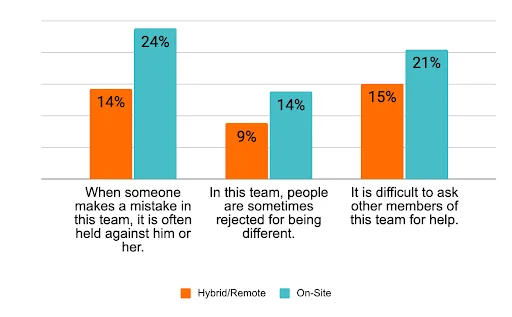
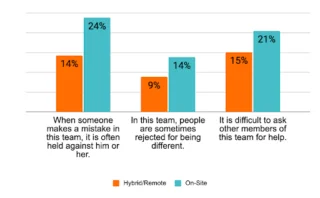
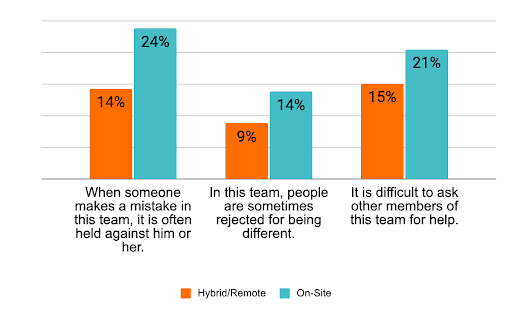
Onsite employees are much more likely than remote/hybrid employees to report negatively about experiences with their team. They are 66% more likely to feel like mistakes are held against them, 56% more likely to say that people are rejected for being different and 36% more likely to find it difficult to ask teammates for help (Figure 1).
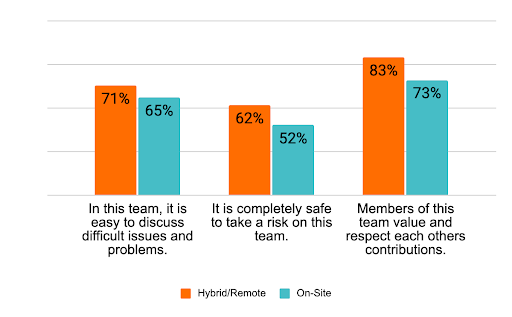
We saw a similar but slightly less dramatic pattern on the items that focus on positive characteristics (Figure 2). Those working onsite are less likely to feel at ease discussing difficult topics, less likely to feel safe taking risks and less likely to feel that the team respects and values each other.
In short, remote and hybrid employees perceive their team environments as having a much higher degree of psychological safety.
It’s not just a different mix of people on site vs remote
We poked and prodded at these findings -- inquiring whether it was age, gender, race/ethnicity or other factors that might explain the differences seen between onsite and remote/hybrid employees. No matter how we cut the data, remote/hybrid employees consistently report higher psychological safety than onsite employees. While the evidence is strong that there is a real difference across work settings, it could be the case that employees in remote settings feel a higher level of psychological safety just because they don’t know what they don’t know. By virtue of being remote, these employees are out of earshot of office common area conversations, and/or less able to read facial expressions on video calls -- either of which may lead to a misperception about psychological safety.
It might be about manager support for mental well-being
While a root cause analysis awaits a more in-depth study, data on manager support for team well-being across these two settings suggests a possible partial explanation for the enhanced psychological safety experienced by hybrid/remote employees. Compared to onsite employees, remote/hybrid employees in our sample were substantially more likely (+10%) to say that their manager is looking out for their well-being. Combined with the stress and strain of a global pandemic, the move of many workers to hybrid and remote settings has made it harder for managers to walk by and see how people are doing. As a result, managers have had to become more intentional as they check in with team members, providing the kind of emotional support that is favorable to psychological safety.
Reluctance to return is more than just the commute
Data from this self check show that almost half (46%) of employees who are currently remote/hybrid would quit their job before they would go back to their normal work site full time. Commuting and work-life balance issues certainly have a role to play. However, there also appear to be real things happening in the onsite setting that impact mental well-being and psychological safety. Collaboration tools may afford just enough physical distance to make people more comfortable weighing in. For what it’s worth, as a career-long remote employee, it’s been my own experience in meQuilibrium’s remote-for-the-first-time environment that when everybody is the same size square on the video call, it’s easier to speak up and be heard.
As employers continue to consider how best to structure the workplace, leaders will need to address this very real gap in psychological safety across work settings in order to ensure that innovation, creativity and change-readiness is not compromised in the return to onsite work.
Download Psychological Safety + Employee Well-being: A 2022 meQ Member Research Report